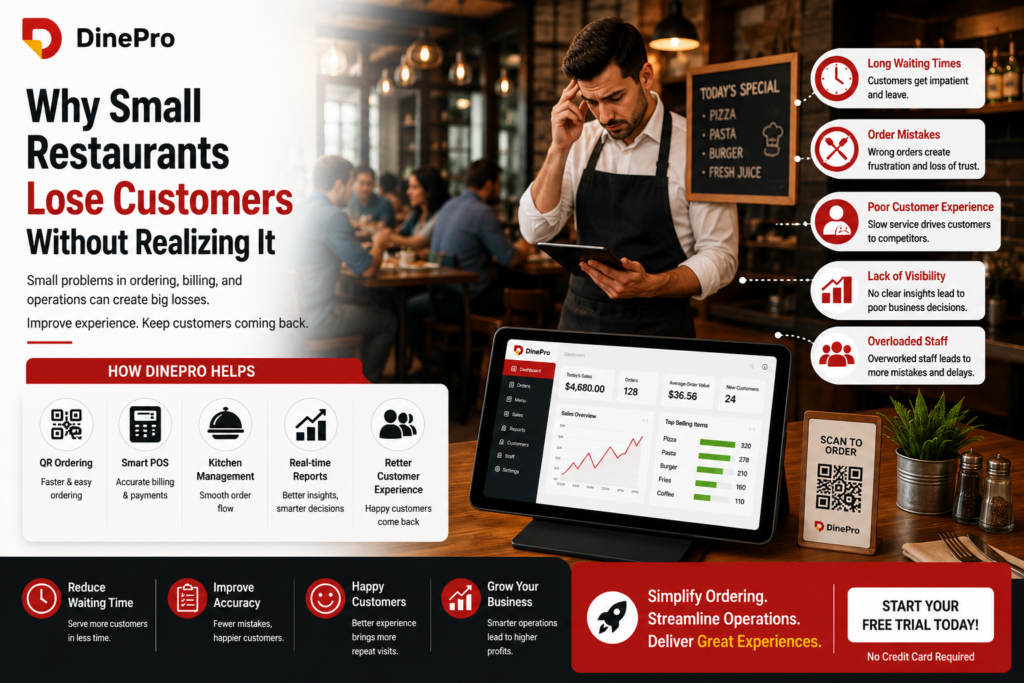
Running a small restaurant is challenging.
Owners manage everything from purchasing ingredients and training staff to handling customers and monitoring daily sales. Because there are so many responsibilities, small operational issues can easily go unnoticed.
A restaurant owner may think:
“The food is good, so customers will come back.”
But today’s customers judge the complete experience.
They remember:
- How quickly they were served
- How easy it was to order
- Whether mistakes happened
- How convenient payment was
- Whether the overall experience felt smooth
A great meal with a frustrating experience can still result in a lost customer.
The Hidden Problems Driving Customers Away
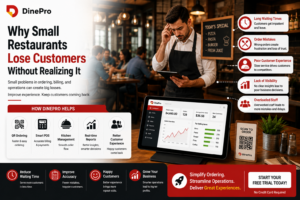
1. Long Waiting Times
Waiting is one of the biggest reasons customers become dissatisfied.
Customers do not only dislike waiting for food. They dislike waiting to:
- Get a menu
- Place an order
- Ask for changes
- Request the bill
- Complete payment
When customers feel ignored or delayed, they associate the problem with the restaurant.
For small restaurants with limited staff, managing multiple tables during busy hours becomes difficult.
A better workflow helps staff focus on service rather than constantly managing manual processes.
2. Order Mistakes Create Frustration
Order mistakes happen in many restaurants.
A customer may receive:
- The wrong dish
- Missing items
- Incorrect modifications
- Wrong quantity
These mistakes create extra work for the kitchen and staff while affecting customer trust.
The problem is often not the employee.
It is the process.
Manual order taking creates more opportunities for miscommunication between customers, servers, and kitchen teams.
Digital ordering systems help create clearer communication between customers and restaurants.
3. Customers Expect Convenience
Customer expectations have changed.
People use technology everywhere:
- Online shopping
- Digital payments
- Mobile bookings
- Food delivery apps
When they visit a restaurant, they expect similar convenience.
Many customers now appreciate options like:
- Digital menus
- QR ordering
- Faster payments
- Easy table service
Restaurants that adopt simple technology can create smoother experiences without making operations complicated.
4. Small Restaurants Often Lack Visibility
Many restaurant owners know their daily sales but lack deeper insights.
Questions like these are difficult to answer:
- Which menu items perform best?
- Which hours are busiest?
- How is staff performance?
- Where are delays happening?
- What trends affect sales?
Without clear information, owners make decisions based on assumptions.
Restaurant management systems help transform daily activity into useful business insights.
5. Staff Pressure Affects Customer Experience
Small restaurants usually operate with limited teams.
During busy periods, staff members handle:
- Taking orders
- Answering questions
- Managing tables
- Preparing bills
- Processing payments
When employees are overloaded, customer experience suffers.
Technology does not replace staff.
It helps staff work more efficiently.
By reducing repetitive tasks, restaurant teams can spend more time creating better customer interactions.
How Small Restaurants Can Improve Customer Experience
Improving customer experience does not always require major changes.
Small improvements can create a big impact:
Make ordering easier
Customers should have a simple way to view menus and place orders.
Reduce unnecessary manual work
Automate repetitive tasks like billing and order tracking.
Improve communication
Ensure customer orders move smoothly from table to kitchen.
Understand your operations
Use reports and analytics to identify improvement areas.
How Restaurant Technology Helps
Modern restaurant technology brings different operations together:
- Digital menus
- QR ordering
- POS systems
- Billing
- Order tracking
- Reports and analytics
Instead of managing separate processes manually, restaurant owners can create a connected workflow.
Platforms like DinePro help independent restaurants manage ordering, billing, menus, and daily operations from one system.
The goal is simple:
Help restaurant owners spend less time managing problems and more time growing their business.
Final Thoughts
Customers do not leave restaurants only because of food quality.
They leave because the overall experience does not meet expectations.
For small restaurant owners, improving speed, convenience, and operational control can create stronger customer relationships.
The restaurants that adapt to changing customer expectations will have a stronger advantage in the future.
FAQs
Why do customers stop coming back to restaurants?
Customers often stop returning because of slow service, poor communication, order mistakes, inconvenient ordering processes, or inconsistent experiences.
How can small restaurants improve customer experience?
Small restaurants can improve customer experience by simplifying ordering, reducing waiting times, improving billing processes, and using technology to manage operations.
Is restaurant technology useful for small restaurants?
Yes. Restaurant technology can help small businesses improve efficiency, reduce mistakes, and provide a better customer experience without requiring large teams.
Want to create a smoother restaurant experience? Explore how DinePro helps small restaurants simplify ordering, billing, and daily operations. Start your free trial today.