Small restaurants are built on passion.
Many owners start their businesses because they love food, hospitality, and serving customers.
But as the restaurant grows, daily management becomes more complex.
Owners often find themselves spending most of their time solving operational problems instead of focusing on growth.
Understanding these challenges is the first step toward building a smoother restaurant operation.
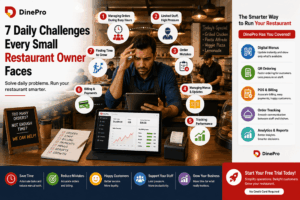
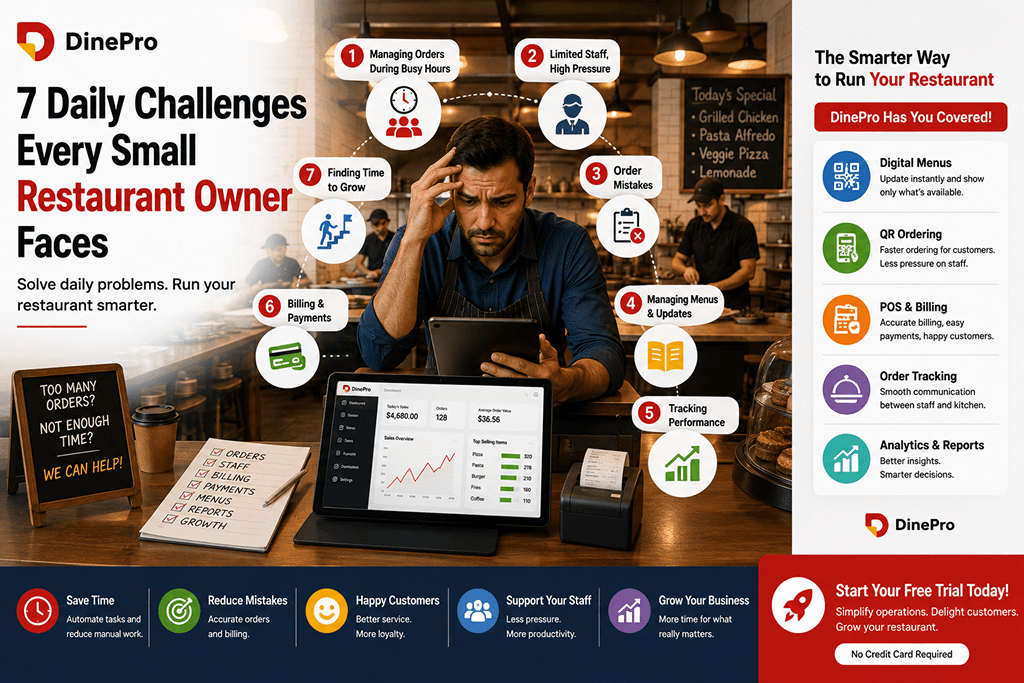
1. Managing Orders During Busy Hours
Peak hours are both an opportunity and a challenge.
When many customers arrive at the same time, restaurant teams need to handle:
- Taking customer orders
- Communicating with the kitchen
- Updating customers
- Preparing bills
- Managing payments
For restaurants using traditional ordering methods, busy periods can quickly become overwhelming.
A small mistake in taking or communicating an order can create a chain reaction:
Customer receives the wrong item.
Kitchen has to prepare another order.
Staff spends extra time fixing the issue.
Customer experience decreases.
The goal is not just serving more customers.
The goal is serving them efficiently.
2. Keeping Customers Happy While Managing Limited Staff
Most independent restaurants operate with smaller teams.
A few employees may handle multiple responsibilities:
- Serving customers
- Managing tables
- Answering questions
- Processing payments
- Coordinating orders
During quiet hours, this may work well.
During busy periods, staff pressure increases.
When employees are overloaded, important details can be missed.
Customers may experience:
- Delayed responses
- Longer waiting times
- Limited attention
Technology can support restaurant teams by reducing repetitive tasks and making daily workflows easier.
3. Reducing Order Mistakes
Order accuracy directly affects customer satisfaction.
A customer who receives the wrong meal may not only become unhappy during that visit but may also avoid returning.
Common causes of order mistakes include:
- Misheard requests
- Handwritten notes
- Communication gaps
- Changes not reaching the kitchen
A smoother ordering process creates better communication between customers, staff, and kitchen teams.
Clear information flow helps restaurants deliver the right order the first time.
4. Managing Menus and Updates
Restaurant menus change frequently.
Owners may need to update:
- Prices
- Available items
- Seasonal dishes
- Special offers
- Sold out items
With traditional menus, every change can become inconvenient.
Printed menus need replacement.
Staff need to remember updates.
Customers may order items that are unavailable.
Digital menus allow restaurants to make updates quickly and provide customers with accurate information.
5. Tracking Restaurant Performance
Many restaurant owners know their total sales at the end of the day.
But running a successful restaurant requires deeper understanding.
Owners need answers to questions like:
- Which items are customers ordering most?
- What are the busiest hours?
- How are sales changing?
- Which areas need improvement?
Without proper reporting, decisions become based on guesses.
Restaurant analytics help owners understand what is happening inside their business.
Better information leads to better decisions.
6. Managing Billing and Payments
Billing should be simple.
But manual billing processes can create unnecessary challenges.
Common problems include:
- Incorrect calculations
- Delayed bill generation
- Payment confusion
- Difficulty tracking sales
Customers expect fast and convenient payment experiences.
Restaurants need billing systems that support accuracy and speed.
A reliable POS system helps connect orders, billing, and payments in one workflow.
7. Finding Time to Grow the Business
The biggest challenge for many restaurant owners is time.
Owners often spend their day managing immediate problems:
A delayed order.
A customer complaint.
A payment issue.
A staff question.
At the end of the day, there is little time left for:
- Marketing
- Improving operations
- Planning growth
- Understanding customers
The right systems help owners move from constantly reacting to problems toward actively improving their business.
How Technology Helps Small Restaurants Overcome These Challenges
Modern restaurant technology is designed to simplify daily operations.
A restaurant management platform can help owners manage:
Digital Menus
Allow customers to access updated menus easily.
QR Ordering
Give customers a faster way to browse and place orders.
POS and Billing
Improve payment accuracy and simplify transactions.
Order Tracking
Create better coordination between front staff and kitchen teams.
Analytics
Provide insights into restaurant performance.
Solutions like DinePro combine these tools in one platform, helping independent restaurants create smoother operations without adding unnecessary complexity.
Why Small Restaurants Should Start With Simple Technology
Many owners believe technology is only useful for large restaurant chains.
That is no longer true.
Small restaurants often benefit the most because they have limited resources.
The right technology can help them:
- Save time
- Reduce mistakes
- Improve customer experience
- Support staff
- Make better decisions
Technology does not replace the personal service that makes small restaurants special.
It helps owners deliver that service more efficiently.
Final Thoughts
Every small restaurant owner faces challenges.
The difference between struggling and growing often comes down to how effectively those challenges are managed.
Better systems create better experiences for customers, staff, and owners.
By adopting simple restaurant technology, independent restaurants can create smoother operations and compete in an increasingly digital industry.
FAQs
What are the biggest challenges for small restaurant owners?
Common challenges include managing orders, reducing waiting times, controlling costs, handling billing, managing staff, and improving customer experience.
How can small restaurants improve efficiency?
Small restaurants can improve efficiency by using digital menus, restaurant POS systems, order management tools, and analytics.
Is restaurant management software useful for small restaurants?
Yes. Restaurant management software helps small restaurants organize daily operations, reduce manual work, and improve service quality.
Running a restaurant should not mean solving the same problems every day. Discover how DinePro helps small restaurants simplify ordering, billing, and operations. Start your free trial today.